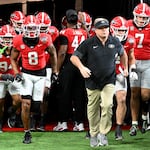
ATHENS — Kirby Smart is all about his team building and player connection, and the head coach indicated college football’s move to one transfer portal has made for a more efficient offseason.
“I would say the biggest investment of time (in the offseason) is the portal and retaining your players, that all falls under roster management,” Smart said when asked by The Atlanta Journal-Constitution how new NIL and transfer rules have affected offseason time allocation.
“In terms of this offseason, this year is different, we haven’t had to (invest time into roster management) since the portal closed, and our roster became our roster and school started,” Smart said. “I haven’t had to invest a lot of time in that because there’s no second portal to retain your roster or go see about somebody else’s, so we’ve been able to focus a lot more on our team.”
Changes brought about by NIL and transfer portal rules has created a series of issues, including what coaches and administrative leaders have referred to as “unintended consequences.”
The NCAA football oversight committee has worked to become more proactive in working to eliminate — or regulate — some of those consequences with proposed legislation designed to put so-called “guard rails” in place to provide some semblance of order.
Most recently, the oversight committee — which includes Georgia athletic director Josh Brooks — has proposed stiff penalties designed to curb tampering and facilitate more of the team building Smart referred to by discouraging transfers outside of the designated portal window.
Under the emergency legislation proposed by the oversight committee to the Division I cabinet for approval, If an enrolled player transfers to another school while not active in the transfer portal, the following actions would occur
- The head coach would be suspended from all football activities for six games
- The school would be fined 20% of its football budget.
The measure will be voted on at the Division I cabinet meeting in April. If passed, the legislation would become effective immediately.
Previously, the NCAA oversight had also requested a loss of five football roster spots the following season, but that was struck from the proposal last week, making it more likely it will be passed
Brooks spoke out about the importance of the legislation in the committee’s initial release last month, released on the NCAA.org website.
“Attempts to circumvent the transfer window process is an issue for the sport,” he said. “We want to let everyone know that this is not going to be allowed, and the committee wants to protect the transfer window that has been established.”
The most recent transfer window ran Jan. 2-16.
College football moved to having only one transfer window this year, something Smart voiced strong support for at the SEC spring meetings last May, calling it “the biggest decision that has to be made in college football … .”
Smart said having a second portal window after spring drills, as had been the case, opens the door for tampering and inhibits effective team building.
“You think tampering is a problem? Put that portal in April and see what teams do in January, February and March,” Smart said last May.
“I think it’s really important in football to have your team (be) your team at whatever date in January, whatever we decide that is, and then you work those guys out. You train those guys, you lift, you prepare, you do meetings and all this preparation, and then that’s your team.”
Smart indicated at his opening spring football news conference last week that UGA has been able to put more time and effort into the players as a result of college football going to one portal window.
The NCAA oversight committee also recently approved what’s being referred to as a “blanket waiver” that allows for FBS programs to designate 16 staff members for off-campus recruiting between April 15 and May 23.
Per the new legislation, the head coach is not required to be included, and programs can’t have more than 10 of their 16 designated off-campus recruiters on the road at the same time.
The corresponding recruiting legislation for Football Championship Subdivision programs is scheduled to have its oversight committee discuss off-campus rules Monday, per the NCAA release.