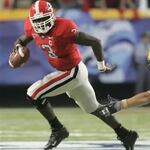
UGA football added to its rich history with this year’s NFL draft domination.
The five Dawgs taken in the first round this past week set an NFL record for the most defensive players out of one school. And, with 15 Dawgs taken, UGA also set a new overall draft record for the modern era (since 1994). Plus, Travon Walker became the fifth UGA player to go as the overall No. 1 pick, tying a mark also held by Notre Dame, Southern Cal and Oklahoma.
Three of Walker’s four Georgia predecessors drafted at No. 1 should be fairly easy for veteran fans to remember or guess off the top of their heads — Matthew Stafford (2009), Charley Trippi (1945) and Frank Sinkwich (1943), but the fourth would make a great sports bar trivia question. It was Harry Babcock, an end who played for Wally Butts at Georgia and frequently was on the receiving end of passes from great Dawgs QB Zeke Bratkowski. Babcock was the No. 1 draft pick of 1953. (He went on to play three seasons for the 49ers.)
Speaking of UGA trivia questions, another toughie would be this: Who was the first Bulldog player ever taken in the NFL draft?

The answer is right under the noses of Georgia Bulldog Club season ticket holders every year, when they make a payment to a scholarship fund named in honor of this player — the William C. Hartman Fund.
I was reminded of that relatively obscure bit of UGA history this week when retired Atlanta sportscaster and fellow Athens native Bill Hartman III dropped me a note about how his daddy was the first Dawg ever drafted by the NFL, 84 years ago.
Bill Hartman Jr. was taken in the 8th round of the 1938 draft by the Washington Redskins, the defending NFL champions, and teammate Pete Tinsley was drafted in the 11th round, by the Green Bay Packers. It was only the third year of the NFL draft. Other UGA players had played in the league before Hartman, but they had not been drafted.
One of the more remarkable aspects of the story, the younger Hartman told me, was that “Big Bill wasn’t so sure he wanted to play. The NFL wasn’t what it is today.”
At the time, he said, his father, a recent UGA graduate, “was working for the Coca Cola Co. as a security agent, traveling to different towns and ordering Coca-Colas in bars and restaurants. If the drink he was served tested out to be something other than the real thing, Coca-Cola would send the restaurant a letter demanding it stop serving generic cola as Coca-Cola. It was fun for a kid just out of college.”
His father was in Green Bay, Wisconsin, when he was drafted, the younger Hartman said, and “at first he told the Redskins no thanks. But, they really wanted him to back up future Hall of Famer Sammy Baugh at tailback (back then, essentially the quarterback).
“It was August of 1938 when they sent him a letter offering him $175 per game and a plane ticket from Milwaukee to Washington. He wrote back, asking if he got the $175 even if he didn’t get into the game. The owner, George Marshall, said yes.”
In that August letter, Skins coach Ray Flaherty noted that, with the team playing a 13-game schedule, those payments of $175 per game would mean Hartman would be paid $2,275 for the season, and, if the team won the division and playoff, he possibly could get another $500.
Said Flaherty: “I hope you will consider this offer; it is very good pay for less than four months work.”
Hartman took that flight to Washington to join the team. As it turned out, Baugh was injured in the preseason, and Hartman started for the first six games. In fact, he threw a touchdown pass in a 26-23 win over the Philadelphia Eagles in what his son proudly noted was “the first professional game he ever saw.”
Later in the season, Hartman also completed 13 consecutive passes in a game against Brooklyn.
The Redskins led the NFL’s Eastern Division until Week 10, when they lost to the Chicago Bears, but the division title still came down to the last day of the regular season, when 57,461 turned out at the Polo Grounds in New York to watch the division-leading Giants play host to the Skins. A Washington win would have made them division champs, but the Giants prevailed, 36-0.
That proved to be Hartman’s only season in the NFL. He decided to quit pro football and return to Athens as backfield coach for the new UGA football coach, Butts, under whom Hartman had played at Georgia Military College in Milledgeville before joining the Georgia Bulldogs.
Recalled his son: “Even though he had a very good rookie year, the new Georgia coach, Wally Butts, offered him more money to be the backfield coach at Georgia.”
Yes, the coaching job at UGA gave Hartman a pay raise over the NFL, to $2,800 a year.
(A 1941 article in The Red & Black student paper unearthed by Bill III reported that his father was sent a contract that year from the Redskins with a blank space where he could fill in his own pay. The paper said he sent it back, unsigned.)
Also, the younger Hartman added, another reason his father returned to Athens is he “wanted to get married to my mother,” Ruth Landers of Savannah, who was his college sweetheart and Miss University of Georgia.
I asked Bill III how his father viewed his brief time in the NFL.
“He was very proud of his time with the Redskins and became great friends with Sammy Baugh,” the retired sportscaster said. “Back when I was a kid in the ‘50s, the Redskins were on Atlanta television every Sunday. He loved reliving his time as we watched.”
(In the days before the Falcons, Washington was the de facto “Southern” NFL team, and I remember my brother Jonathan asking for a Redskins uniform that was in the Sears Christmas catalog we received.)
Was Hartman proud of being the first Bulldog drafted?
“He never talked about being the first UGA player drafted,” his son said.
In fact, Bill III didn’t realize his father held that distinction until he researched it a few years ago. “Georgia didn’t have any great players in the ‘35 or ‘36 season. He was an All American in ‘37, so it made sense, in the NFL’s third draft, he would be the first UGA player drafted.”
Playing fullback, linebacker and kicker at Georgia, during a time when players didn’t specialize, Hartman had set a Georgia record by punting the ball 82 yards against Tulane in his senior year. (That punt still ranks second to Spike Jones’ 87-yarder against Auburn in 1967.) Hartman also still holds the Georgia record for most punts in a game: 14 against Auburn in 1937, which helped the Dawgs get a 0-0 tie against a much lauded Tigers team that went on to win the Orange Bowl.
Two weeks later, against Georgia Tech, Hartman fielded a second-half kickoff and, after initially fumbling the ball, ran 93 yards for the tying touchdown. The game ended 6-6 because, Hartman later recalled, “I missed the extra point. I was so winded, I wanted a timeout, but the officials wouldn’t allow it.”
I asked Bill III whether his dad had a favorite memory of his time with the Redskins.
“He just enjoyed talking about his friends on the team, not really a favorite moment,” the younger Hartman said. “I wish I had pressed him on it. His 62-yard touchdown pass to Bill Young in the third quarter that beat the Eagles 26-23 on Sept. 11, 1938, must have been a thrill.”
After being on Butts’ staff during seasons that saw the Bulldogs win the Orange Bowl, the Rose Bowl and a national championship, the elder Hartman left his coaching job at UGA to serve in the Army’s Counter Intelligence Corps in World War II.
Returning to Athens, he went into the insurance business, and also spent several more years as an assistant coach for Butts. He became a civic leader in Athens, serving on the City Council, and was a leading supporter of UGA, being named a trustee and president of the Alumni Association. In 1960, he became chairman of what was then known as the Georgia Student Educational Foundation, to raise private funds for athletic scholarships, a post he held for many years. He also was an ace fundraiser for the university, and was credited with arranging the single largest gift ($10 million) ever given to UGA.
There was more to Hartman’s football career, too. In the early 1970s, he returned to the Bulldogs’ football staff, working with punters and placekickers, including Georgia legend Kevin Butler, as the “volunteer kicking coach.”
When the NCAA changed its rules about volunteer coaches in 1992, he enrolled in graduate school, so that he could continue working with the Dawgs’ kickers as a graduate assistant — laughingly dubbed the “oldest G.A. in the history of the game” by Vince Dooley.
Hartman finally retired from coaching after the 1996 season, his son said. “He was 81.”
After Hartman’s death in 2006, the day before his 91st birthday, the donation priority system he had founded was renamed in his honor. “I don’t think anybody has done more for the university from both the academic and athletic standpoints,” Dooley said at the time.
Hartman was named to the Sports Illustrated Silver Anniversary All America Team in 1962, the Georgia Sports Hall of Fame in 1981, and the National College Football Hall of Fame in 1984. In 1992, UGA announced the creation of the Bill Hartman Award, for athletes who had distinguished themselves as alumni.
And, so, Bill III said, “That’s the story of the first University of Georgia player ever drafted.”
As for the latest Dawgs to go in the NFL draft, Bill noted — with great understatement — that they “will do much better than $175 a game.”
(Special thanks to Steve Colquitt, Jason Hasty, Yvonne Zusel and Bill Hartman III.)