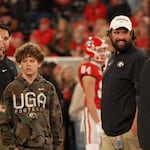
Loser: Kirby Smart
For the second College Football Playoff game in a row, Smart was out-coached by his own admission.
“They made more plays than we did; and I’ve got to be honest, that’s part of football,” Smart said. “They made more, and outexecuted us, outcoached us, outplayed us.”
The two most glaring examples came on the fourth down decision to go for it from Georgia’s own 33-yard line and on what was Georgia’s final third-down of the game.
Smart admitted fault on the fourth-down call. Running the punt team-offense switcharoo, something Notre Dame first did to Georgia last season, wasn’t uncommon for the Bulldogs to do. But doing so with Malachi Toliver at center, instead of the injured Drew Bobo, probably should’ve been a bigger factor.
The play worked in games against Mississippi State and Texas, when Bobo was on the field.
“Yeah, we screwed that up a little bit. We had a misfire there,” Smart said. “It was a change-up from the look we had done twice. And we knew teams were going to sit back and not honor us, because we had not snapped it on those plays in two different locations, two different times. And the ball was not supposed to be snapped in that situation.”
As for the third-down decision on Georgia’s last drive, Smart stuck to his guns in the postgame news conference. He didn’t want to play for overtime. Given Ole Miss scored touchdowns on all four of its redzone possessions, compared to Georgia kicking not one but two redzone field goals, you can somewhat see why playing for overtime may not have been something Georgia felt confident in.
Georgia’s defense, whether the offense scored a touchdown or not, was going to need a stop in regulation regardless of the third-down play call. That did not happen.
“They played to win the game, and we played to win the game,” Smart said. “We didn’t play to go to overtime, because a lot of people would have said, Oh, third and 5, let’s just run it and milk the clock out or they’ll call timeout. They went for it, and they made a good play.”
It’s easy to second-guess decisions in hindsight. No coach is going to nail every call. Still, the Bulldogs were supposed to be the team that had the edge in managing tight in-game calls, with Smart having been a head coach in 136 more career games than his Ole Miss counterpart, Pete Golding.
There’s still no one you’d want to be running your program more than Smart, especially when you factor in all a head coach has to do in this day-and-age.
But Georgia needed Smart to be better against Ole Miss. That is partially why the season-ending defeat felt even more crushing.
Winner: Colbie Young
In this day-and-age of college football, it’s easier than ever to demonize players. With the transfer portal and NIL, you’re more likely to see players put themselves before the team.
That makes what Young did all the more admirable.
After missing six games because of a leg fracture, Young returned to the Georgia lineup. He caught 2 passes for 44 yards, while also drawing two key pass interference penalties.
For a passing game that was extremely reliant on Zachariah Branch, Young gave quarterback Gunner Stockton a much-needed security blanket who could make the tough downfield catches.
Young played 31 snaps against Ole Miss. Those would be his final in a Georgia uniform.
“It meant everything,” Young said. “Unfortunately, this is my last game, and I got to be out there to contribute to this team. I couldn’t ask for anything more.”
Young should’ve had a better career at Georgia. His talent was obvious and his work ethic showed through in his push to return from injury. A suspension in 2024 and the injury in 2025 make him a rather large what-if for this era of Georgia football.
For now though, Young deserves to be lauded for what he brought to Georgia in the 2025 season. That he pushed to return and made an impact for the Bulldogs speaks volumes about his football character.
Loser: Georgia’s pass rush
The absence of Gabe Harris was felt against Ole Miss. He had been one of Georgia’s most improved defenders over the closing stretch of the season and his various replacements against Ole Miss just didn’t get the job done.
For the second-straight game against Ole Miss, the Bulldogs had zero sacks. It couldn’t get to Trinidad Chambliss. When it got close, the Ole Miss quarterback slipped away often.
“Their quarterback is just incredible,” Smart said. “I mean, he does an unbelievable job of not giving up sacks and making plays with his legs.”
Chambliss played as well as any quarterback has ever done so against a Smart team. He threw for 362 yards and 3 touchdowns, dropping dime after dime on the Georgia secondary. Sometimes, good offense beats good defense.
But this Georgia defense, while good, was far from great. The Bulldogs finished with just 20 sacks this season, the fewest of Smart’s tenure.
Georgia simply has to be more effective in getting to the quarterback next year if it is to have a longer season. Some of the struggles can be chalked up to youth, as Tray Scott noted this was the youngest defensive line room he has ever coached. Bringing back players such as Elijah Griffin, Joseph Jonah-Ajonye and Harris will go a long way to having a more disruptive defensive line.
Quintavius Johnson deserves praise for how he played this season and against Ole Miss. While he couldn’t get to Chambliss, he did have multiple pass deflections. Another year in the Georgia system should do wonders for him.
Georgia went out last offseason and added Elo Modozie via the transfer portal. It remains to be seen if Georgia goes and spends the kind of money necessary in the transfer portal to get a true difference maker off the edge.
Georgia doesn’t need to have the best pass rush in the country next season. They do enough things well as a defense that it doesn’t need to be a strength.
But it cannot be such a glaring weakness as it was in 2025.
Winner: The 2025 Georgia football team
For much of this season, Georgia did not feel like a national championship-winning team. The Texas and Alabama games changed that feeling, but after seeing Alabama get rocked against Indiana, that win isn’t as impressive as it felt in the moment.
For as much as it might sting in the wake of a season-ending loss, this 2025 Georgia team still accomplished plenty to be proud of. The Bulldogs won the SEC, swept its annual rivals once again and did beat Alabama in Atlanta for the first time in school history.
The win over Texas shouldn’t be forgotten, especially given all the offseason love the Longhorns received. A loss in the Sugar Bowl is still a far better ending than a win in the Cheez-It Bowl.
This team could’ve folded plenty of times throughout the season. The games against Tennessee, Auburn and Ole Miss stand out, with Georgia rallying from multiple-score deficits to win all three games. That takes real toughness and character.
Smart began the year speaking about how young this Georgia team was. It undoubtedly grew up this season.
The hope is that the gains made this season, coupled with the motivating loss at the end, power Georgia through the offseason. This team was flawed but good.
“I am proud of our team. I’m sick that we lost, and there’s things I would love to go back and do differently,” Smart said. “But I’m just so proud of the way our guys competed when down 10, and just didn’t finish it.”
That it still found a way to accomplish so much should still be celebrated, even if the ending won’t be remembered fondly.
Loser: Georgia fan turnout in New Orleans
Georgia is one of the most passionate fan bases in the country. They normally travel well and go to great lengths to support their team.
Which makes the fan situation in New Orleans all the more jarring.
Ole Miss had a decided advantage in fan support in New Orleans. Not just in numbers but in noise. It felt closer to an Ole Miss home game than a neutral-site game.
“It felt very different than last year in terms of the environment and everything,” Smart said. “Great crowd out there today. Probably more partisan Ole Miss than ours, but it felt like you’re on a road game with their atmosphere. And they had momentum a lot.”
There are legitimate reasons why Ole Miss had the edge in that regard. New Orleans is considerably closer to Oxford, Mississippi, than it is to Athens. Add in the Lane Kiffin factor — Kiffin made his feelings on Ole Miss fan support well known throughout this season — and you had a motivated group of people eager to prove their former coach wrong.
Perhaps Georgia fans had their eyes on bigger games ahead. The Bulldogs have never played in the Fiesta Bowl and maybe some fans were hoping to save their travel funds for that game. Maybe some were looking ahead to the national championship game as well. Plus, Georgia had already beaten Ole Miss this season and maybe some assumed it would simply happen again.
Ole Miss didn’t win the game because it had a greater fan turnout. The Rebels just made more plays than Georgia.
Georgia fans will undoubtedly rebound from this game, both in terms of morale but also support. Home games against Oklahoma and Vanderbilt will be raucous atmospheres.
Perhaps this result will serve as a reminder that no College Football Playoff game should be taken for granted. As Smart noted, the whole point of the system is to create games like this one.
“It was an incredible college football game,” Smart said. “It’s what the CFP was built for, to have battles like that.”
Maybe moving forward, in an expanded field, Georgia would get to host Ole Miss in a quarterfinal, instead of having to feel like it played a road game.